

Masai Mara vs Serengeti: Which Is Better for Your Safari?
The short answer
The Serengeti and the Masai Mara are one ecosystem split by the Tanzania–Kenya border, and the Great Migration moves between them. The Serengeti is about ten times larger, holds the herds for most of the year and feels wilder and less crowded. The Masai Mara is smaller, easier to reach from Nairobi and has very dense wildlife, but it is at its best mainly from July to October. Choose the Serengeti for a longer safari or travel outside July–October; choose the Mara for a shorter trip in peak migration season, or combine both.
Masai Mara vs Serengeti at a glance
| Serengeti (Tanzania) | Masai Mara (Kenya) | |
|---|---|---|
| Size | 14,750 km² | About 1,510 km², plus surrounding conservancies |
| Migration herds present | Most of the year | Mainly July–October |
| Best for | Calving season (Jan–Mar), river crossings, space and solitude | Peak river crossings, big cats, short trips |
| Crowds | Spread across a huge area; busy only around central Seronera and the crossing points in peak season | Busy reserve in peak season; private conservancies limit vehicles |
| Getting there | 7–8 hours by road from Arusha, or 1–1.5 hours by air | 5–6 hours by road from Nairobi, or about 45 minutes by air |
| Park fee (non-resident adult, 2026) | $82.60 per 24 hours high season, $70.80 low season | $200 per day July–December, $100 per day January–June |
| Ideal stay | 3–4 nights | 2–3 nights |
Where the migration is, month by month
The herds spend roughly eight months of the year in Tanzania and three to four in Kenya. Exact timing shifts with the rains every year.
| Months | Serengeti (Tanzania) | Masai Mara (Kenya) |
|---|---|---|
| December–March | Southern plains and Ndutu: calving season January–March | Herds absent; resident wildlife and big cats remain excellent |
| April–May | Central Serengeti, moving north in the long rains | Herds absent; green season, lowest prices |
| June–July | Western Corridor: Grumeti River crossings | First herds arrive in July |
| July–October | Northern Serengeti: Mara River crossings near Kogatende | Mara River crossings; herds spread across the reserve and conservancies |
| November | Herds moving south again | Herds leaving for Tanzania |
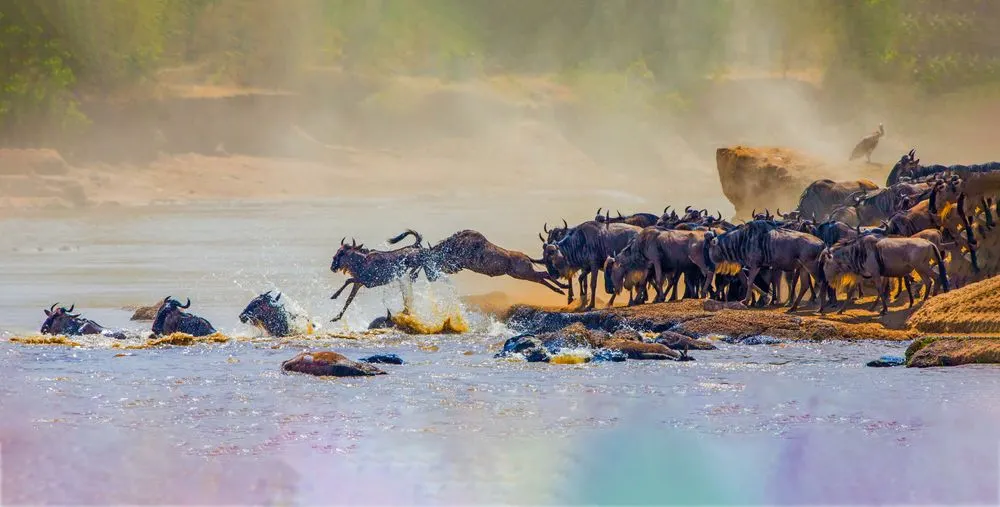
The Mara River crossings happen on both sides of the border. In Tanzania's northern Serengeti you watch them with far fewer vehicles than at the busiest crossing points in the Mara. See our Great Migration safaris.
Crowds and the safari experience
- Serengeti: at 14,750 km², most areas feel empty even in high season. The busiest zones are central Seronera and the northern crossing points in August.
- Masai Mara reserve: compact and easy to reach, so popular sightings and crossing points can draw many vehicles from July to October.
- Mara conservancies: private areas around the reserve, such as Naboisho, Olare Motorogi and Mara North, limit the number of vehicles and allow walking safaris and night drives. If you choose the Mara, staying in a conservancy makes the biggest difference to the experience.
Costs and park fees
Park fees are the biggest difference in cost. From July to December, a Masai Mara day costs a non-resident adult $200 in fees, more than double the Serengeti's $82.60. Lodge prices are broadly similar at the same level of comfort.
| Example: 3 days in peak season, per adult | Serengeti | Masai Mara |
|---|---|---|
| Park fees alone | About $248 | About $600 |
Mara fees are charged per day; Serengeti fees per 24 hours. Mara conservancies charge their own fees instead of reserve fees for days spent in the conservancy.
Sample trips and starting prices
| Trip | Length | From (per person, USD) |
|---|---|---|
| 6 Days Tanzania Wildlife Safari (Tarangire, Serengeti, Ngorongoro) | 6 days | $1,800 |
| 5 Days Classic Kenya Safari (Masai Mara, Nakuru, Naivasha) | 5 days | $1,877 |
| 10 Days Kenya & Tanzania Big Five Safari | 10 days | $3,779 |
| 9 Days Kenya & Tanzania: Mara River Crossing & Ngorongoro | 9 days | $4,028 |
All our prices include park fees, accommodation, meals, a private vehicle and guide. See what a Tanzania safari costs for full price tables.
Which should you choose?
| Choose the Serengeti if you | Choose the Masai Mara if you |
|---|---|
| Travel between December and June, when the herds are in Tanzania | Travel between July and October and have limited time |
| Want the calving season (January–March) | Are flying into Nairobi or combining with Kenya's coast |
| Want space, fewer vehicles and a longer safari | Want a short, high-impact safari of 2–3 nights |
| Want to add Ngorongoro Crater, Tarangire or Zanzibar | Want walking or night drives in a private conservancy |
Combining the Masai Mara and the Serengeti
From July to October you can follow the migration across both. Most combined trips start in Nairobi, spend 2–3 nights in the Mara, then cross to Tanzania by road at Namanga or by a short flight to Arusha or Kilimanjaro, before continuing to the Serengeti and Ngorongoro. Allow at least 9–10 days. Our Kenya & Tanzania safaris are built around this route.
There is no direct border crossing inside the ecosystem for visitors, so you cannot simply drive from the Mara into the northern Serengeti.
Frequently asked questions
Is the Masai Mara or the Serengeti better?
Neither is better all year. The Serengeti is larger, quieter and has the herds for about eight months of the year, including the calving season. The Masai Mara is easier to reach and excellent from July to October, when the herds are in Kenya.
Is the Masai Mara part of the Serengeti?
They are the same ecosystem, divided by the Kenya–Tanzania border. The Mara is the northern tip of the Serengeti–Mara ecosystem, and the wildebeest cross freely between them.
When is the best time to see the river crossings?
July to October, at the Mara River. Crossings happen on both sides of the border: in Kenya's Masai Mara and in Tanzania's northern Serengeti around Kogatende.
Which is cheaper, the Masai Mara or the Serengeti?
In peak season the Serengeti is usually cheaper, because Mara park fees are $200 per adult per day from July to December against $82.60 in the Serengeti. From January to June, Mara fees fall to $100 per day.
Can I visit both on one trip?
Yes. A combined Kenya and Tanzania safari of 9–10 days or more lets you see the Masai Mara, the Serengeti and the Ngorongoro Crater. Most trips cross the border by road at Namanga or by a short flight.
How many days do I need?
Plan 3–4 nights for the Serengeti and 2–3 nights for the Masai Mara. For both, plus Ngorongoro, allow at least 9 days.
Plan your migration safari
Tell us your dates and we will recommend the right side of the border for when you travel, with a tailored itinerary from our Arusha team within 24 hours.