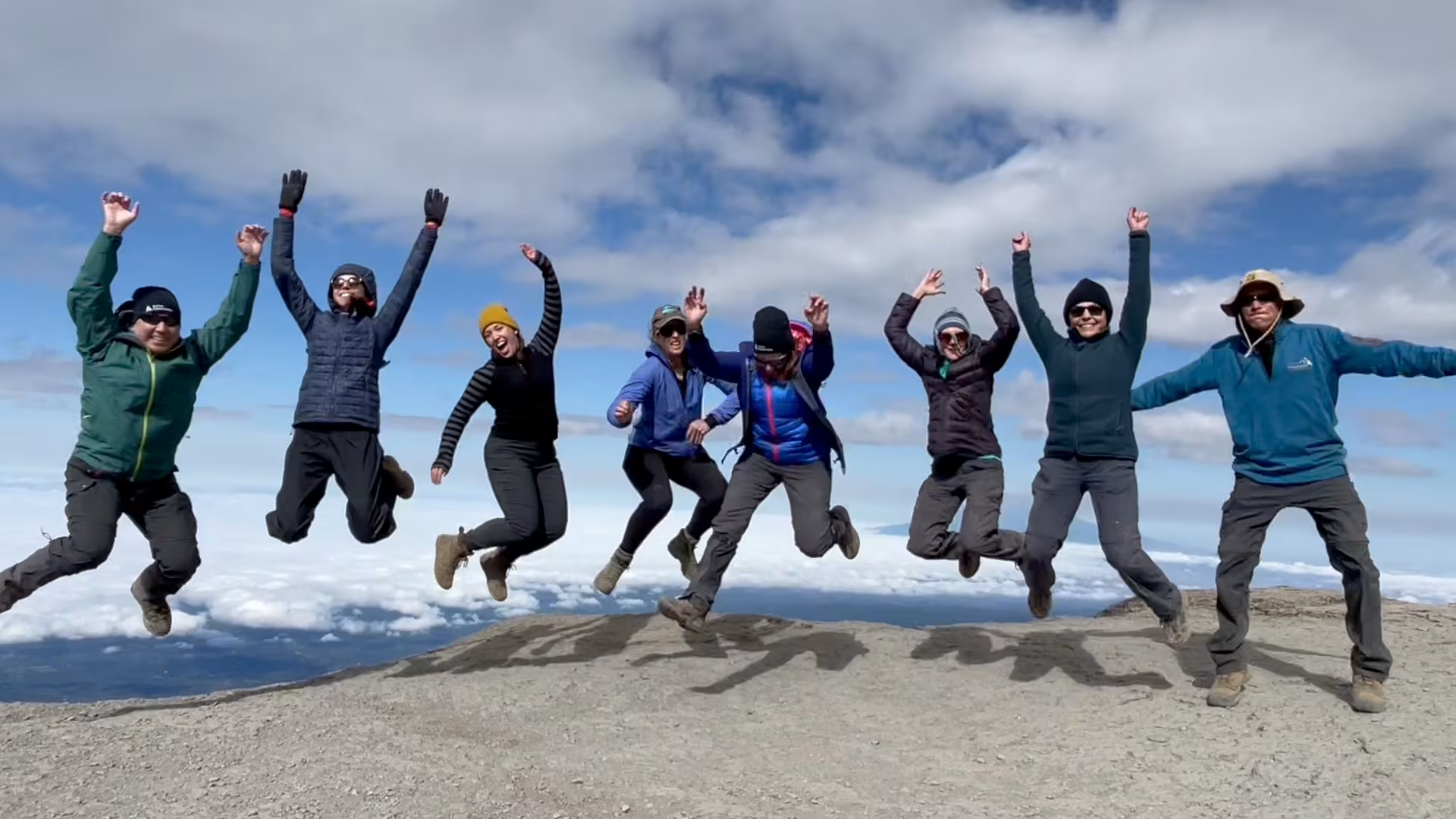
Imagine starting your trek inhaling the scent of damp moss in a humid rainforest, only to finish it a week later surrounded by arctic glaciers. This dramatic shift through five distinct climate zones is the signature experience of the Lemosho Trail Kilimanjaro.
While many hikers mistakenly believe the shortest path offers the best chance at the peak, professional guide data reveals the opposite. The Mount Kilimanjaro Lemosho Route takes a longer, scenic approach that allows your body to adapt to the thin air. Consequently, Mount Kilimanjaro summit success rates exceed 90% for eight-day treks, far outperforming the hurried pace of the shorter “Coca-Cola” route.
The 7 vs 8-Day Dilemma: How One Extra Night Boosts Your Success Rate
When booking your adventure, you might be tempted to save money and time by choosing the shorter itinerary. However, on Kilimanjaro, “fast” is often the enemy of “successful.” Data from park authorities consistently shows that the Lemosho route 8 days itinerary yields a summit success rate exceeding 90%, whereas the Lemosho route 7 days version drops significantly lower, often hovering around 85% or less. That single extra day isn’t just about leisurely walking; it is a strategic investment in your body’s ability to handle thin air without crashing.
Think of altitude sickness prevention on Kilimanjaro like a deep-sea diver returning to the surface; you need pause points to let your internal pressure equalize. This biological adjustment is called acclimatization. By adding 24 hours to the trek, you allow your bone marrow time to ramp up red blood cell production. This process is supercharged by the “Climb High, Sleep Low” principle: hiking to a higher elevation during the day to trigger your body’s adaptation response, then descending to sleep so your system can recover.
Here is how that extra day alters the altitude profile:
- 7-Day Itinerary: Forces a long, aggressive push across the plateau, keeping your body under constant stress with less recovery time.
- 8-Day Itinerary: Splits the long trek across the Shira Plateau, reducing daily physical strain.
- The Sleep Benefit: The 8-day option adds a night at Shira 2 Camp (12,500 ft), a critical stepping stone before attempting the higher Lava Tower.
Choosing the longer option fundamentally changes how you feel during the hike. Instead of fighting nausea or fatigue, you can actually enjoy the unique scenery. This additional time allows you to comfortably navigate the vastness of the mountain, specifically setting you up for success as you begin crossing the Shira Plateau.
Crossing the Shira Plateau: How the ‘Clockface’ Route Optimizes Your Body
Visualize the mountain like a giant watch face to understand why this itinerary works. While shorter paths rush straight up from the South at the 6 o’clock position, the kilimanjaro lemosho route map traces a wide arc starting from the West at 9 o’clock. This specific geometry requires you to traverse nearly half the mountain’s circumference before finally turning upward toward the summit. It transforms the hike from a steep, vertical sprint into a gradual, semi-circular journey that eases your body into the environment.
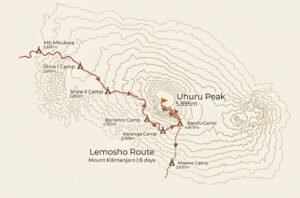
Leaving the dense rainforest after camping at Mti Mkubwa camp, you emerge suddenly into a sprawling, prehistoric landscape. You are now climbing Kilimanjaro via Shira Plateau, traversing the remains of a collapsed volcanic crater known as the Shira Caldera. To your left stands the jagged Western Breach, a massive wall of rock that marks the edge of the true summit cone. This high-altitude desert offers unobstructed views of Kibo peak, providing a constant visual reminder of your ultimate goal.
Trekking across the Shira Caldera offers a distinct physiological advantage found on no other route. You spend an entire day walking on flat terrain at roughly 11,500 feet, which allows your body to adjust to the lack of oxygen without the added stress of climbing steep inclines. This sustained exposure to high altitude builds the red blood cell foundation you will rely on during the difficult days ahead. With your acclimatization base established on the flats, you are ready to tackle the scrambling adventure of the Barranco Wall.
The ‘Kissing Rock’ and the Barranco Wall: Mastering the Only Scramble on the Trail
Standing at the base of the Great Barranco Wall often triggers a moment of doubt because, from the bottom, it looks like a sheer cliff face. However, the visual intensity is deceptive. After hiking from lava tower to barranco valley, you aren’t facing a technical rock climb that requires ropes or harnesses, but rather a fun “scramble.” Think of this as an adult jungle gym; you simply use your hands for balance to step up large rocks while your feet do the heavy lifting. This dynamic section breaks up the monotony of the kilimanjaro climb lemosho itinerary, engaging your upper body and offering a welcome change of pace rather than a terrifying ordeal.
Midway up the face, you will encounter the trail’s most famous obstacle: the Kissing Rock. This narrow section requires you to hug the stone face to shimmy around a ledge, bringing your cheek close enough to “kiss” the wall. When asking how difficult is the barranco wall, the answer lies in simple technique rather than brute strength. By maintaining “three points of contact”, keeping three limbs on the rock while moving the fourth—you ensure total stability. Mastering this coordination builds the exact mental focus you will need for the steep slopes on summit night.
Midnight at Stella Point: How to Manage the Final Push to Uhuru Peak
Waking up at 11:00 PM for tea and biscuits marks the start of the most physically demanding portion of your journey. Guides schedule this midnight departure from Barafu Camp to utilize the frozen ground; the loose volcanic gravel, or “scree,” creates firm footing only while the temperature remains low enough to bind the soil. While the best time to climb kilimanjaro for weather generally falls during the dry seasons, summit night is universally frigid, often dropping from freezing at camp to an intense -20°F (-29°C) higher up. This six-hour ascent in the dark requires a slow, rhythmic pace, matching your breathing to your steps as you follow the winding trail of headlamps upward.
The arrival at Stella Point represents a massive psychological victory because the steep incline finally levels off, signaling that the hardest climbing is behind you. The experience of reaching uhuru peak from stella point takes about 45 minutes on a gradual slope, serving as a victory lap where you pass majestic glaciers just as the sun rises over the African continent. Because the wind chill here is severe, your mount kilimanjaro packing list for beginners must include heavy mittens and insulated layers to protect exposed skin during this final stretch. Standing on the Roof of Africa proves that the long preparation was worth every step, leading directly to the practical decisions needed to secure your own expedition.
Your 3-Step Strategy for a Successful Lemosho Booking
You have moved from simply admiring the “Roof of Africa” to understanding the strategy required to stand on it. Choosing the Lemosho route transforms a grueling gamble into a calculated, achievable expedition. To secure your summit success:
- Select 8-day lemosho route tours to maximize acclimatization.
- Book during the dry windows of Jan/Feb or Aug/Sept.
- Begin training for kilimanjaro trekking six months early, focusing on duration over speed.
While the cost of climbing kilimanjaro with a guide varies, prioritizing experience over price ensures you reach the peak safely.