Imagine arriving for a dream safari only to find the plains empty because the main event moved on weeks ago. A common misconception among travelers is that the migration is a single, fleeting event to “catch,” but it is actually a permanent, 365-day cycle that never truly stops.
Think of the herds as a hungry crowd following a “moving buffet” rather than a fixed map. Rainfall patterns act as the conductor, triggering the growth of nutrient-rich grasses that pull nearly two million wildebeest across the ecosystem in a restless search for food.
Ecologists and local guides describe this journey as a massive clockwise rotation spanning the Serengeti and Maasai Mara. While nature avoids strict itineraries, historical great migration timeline data reveals a consistent rhythm, from the vulnerable calving season in the south to the dramatic river crossings in the north.
Success requires matching your dates to these shifting ecological stages. The following Serengeti Great Migration monthly calendar allows you to position yourself exactly where the action happens.
January to March: The Miracle of the Southern Serengeti Birthing Season
As the short rains revitalize the landscape, the herds congregate in the Southern Serengeti and Ndutu regions. They aren’t just picking a random spot; they are following a geological map to short, nutrient-dense grasses grown on ancient volcanic ash. This specific diet provides the high levels of calcium and phosphorus mothers need for lactation, effectively turning these mineral-rich plains into a massive, essential nursery.
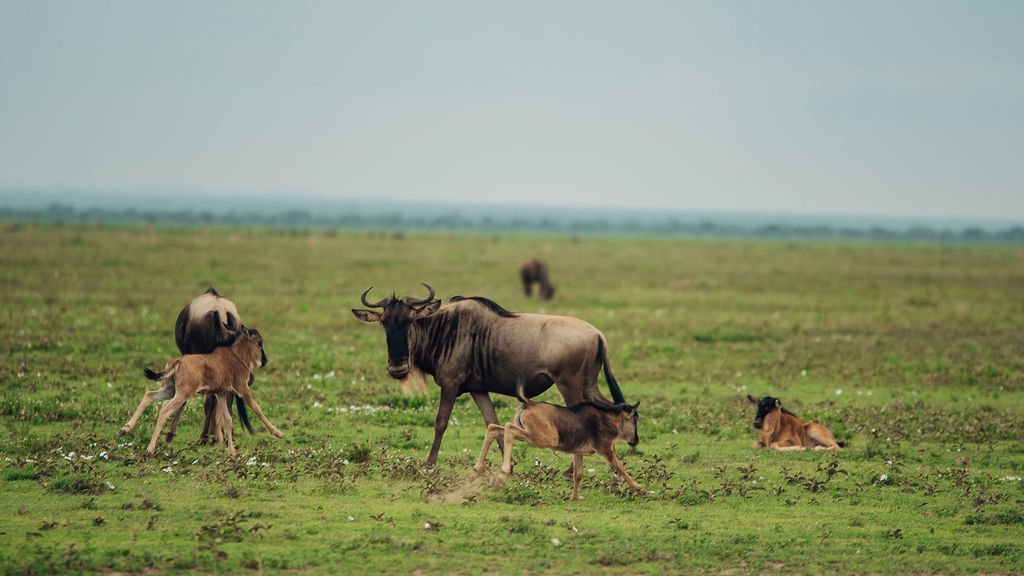
The wildebeest calving season in the Southern Serengeti is a masterclass in survival through numbers. During a peak three-week window centered around February, approximately 8,000 calves are born every single day. This synchronized explosion of life overwhelms local threats, there are simply too many babies for the hunters to eat them all, ensuring the majority of the next generation survives to join the endless loop.
Of course, such a concentration of vulnerable life inevitably attracts unwanted attention. The open plains of the Ngorongoro Conservation Area wildebeest birthing grounds offer little cover, turning the season into a time of high drama. Travelers visiting during this window should expect intense interactions, as the region hosts a high density of apex hunters, including:
- Cheetahs utilizing the flat terrain for high-speed chases.
- Lions capitalizing on the limited mobility of newborns.
- Hyenas patrolling the fringes for separated calves.
To find the herds in February, look to the open plains south of Seronera. However, this time of plenty cannot last forever. As the nutrient-rich grasses are grazed down and the southern plains begin to dry out in late March, the herds grow restless, preparing to abandon the nursery for the long, perilous trek toward the Western Corridor.
April to June: The Great Trek West and the Grumeti River Obstacle
By April, the nursery phase ends abruptly as the “Long Rains” begin to sweep across the ecosystem, triggering a massive exodus toward the northwest. This weather shift transforms the scattered grazing herds into distinct columns stretching for miles, following a scent of rain that leads them into the Western Corridor. Tracing their path on an annual wildebeest migration route map reveals them funneling into a narrow channel of land stretching toward Lake Victoria. The journey is slow and wet, often bogged down by black cotton soil, but the promise of fresh grazing keeps the mega-herd moving relentlessly forward.
Amidst this muddy trek, the rhythm of the migration changes from a steady march to a chaotic frenzy known as “the rut.” During May and June, half a million wildebeest mate in less than a month, creating an atmosphere charged with noise and testosterone. Males stake out temporary territories even while moving, clashing horns and grunting incessantly to secure mates before the dry season intensifies. This biological urgency adds a layer of unpredictable energy to the movement, ensuring the next generation of calves is conceived just as the previous one learns to run.
The column eventually halts at the banks of the Grumeti River, the first major hydro-barrier standing between the herds and the northern plains. While these events are generally less famous than the sheer cliffs of the Mara River later in the year, the grumeti river crossing viewing points offer a unique, intimate brutality. Here, the water is often shallower but infested with massive Nile crocodiles that have waited patiently for this annual delivery. The herds pool on the banks, sometimes for days, building pressure until a single brave individual plunges in, triggering a panicked, splashing dash for the opposite shore.
Choosing to visit during this window requires weighing the dry season safari versus green season trade-offs carefully. While the heavy rains can make roads challenging and the lush vegetation makes spotting smaller predators difficult, the trade-off is solitude and vibrant, emerald landscapes devoid of tourist crowds. For those willing to brave the mud, the reward is seeing the migration in its most raw, energetic state before the survivors turn north, aiming for the dry-season refuge that awaits them in Kenya.
July to September: High Drama at the Mara River Crossings
By July, the focus of the migration shifts dramatically to the northern Serengeti, specifically the Kogatende area. This is the stage most travelers envision when they dream of the Great Migration: high-stakes drama, sheer cliffs, and the iconic “leap of faith.” As the dry season reaches its peak, the herds are forced toward the Mara River, the only permanent water source remaining in the ecosystem. It is no longer just a trek for food; it is a daily gauntlet for survival against the massive Nile crocodiles that patrol these waters.
The action concentrates heavily around the kogatende and lamai wedge river crossings, areas located in the far north of Tanzania near the Kenyan border. While many assume the herds simply cross once into Kenya and stay there, the reality is far more chaotic. The wildebeest often zigzag back and forth across the river multiple times in search of the best grazing, meaning the “crossing season” is actually a series of frantic, confused events rather than a single coordinated movement.
Predicting the best time to see mara river crossings involves understanding animal psychology more than reading a calendar. The herds do not operate on a schedule; they are driven by fear and thirst. Thousands of animals may gather on a riverbank for hours—or even days—staring nervously at the water, only to turn around and retreat. It often takes just one animal, pushed by the crush of the crowd or sheer desperation, to take the first plunge and trigger a chaotic, adrenaline-fueled cascade.
The serengeti vs maasai mara migration timing is essential for planning. While Kenya’s Maasai Mara is famous for these events, the Northern Serengeti in Tanzania offers the same spectacle, often with fewer crowds, from July through October. Because the ecosystem is one contiguous landscape, the herds circulate freely between the Lamai Wedge in Tanzania and the Mara Triangle in Kenya, often crossing the border multiple times before the season ends.
Since a river crossing can happen in five minutes or take five days to materialize, success requires a specific strategy. To maximize your chances of witnessing this natural phenomenon, keep these “river wait” tactics in mind:
- Patience is currency: Be prepared to sit by the river for hours; bring a book and snacks, as false starts are common.
- Silence matters: Even a loud voice or an engine revving can spook the lead animal, resetting the entire waiting process.
- Vehicle positioning: Trust your guide to position the car where the animals will likely exit the river, which often offers better photographic angles than the entry point.
- Optics: Keep binoculars trained on the lead animals to spot the “head-bobbing” motion that usually signals a decision to jump is imminent.
Once the northern pastures are grazed down and the first clouds of the “Short Rains” appear in late October, the herds will collectively turn south, beginning the long march back to the calving grounds.
October to December: The Return Journey and the Short Rains
As the dry season loses its grip in late October, a sudden atmospheric shift triggers the herds to turn their backs on the Mara River. The impact of rainfall patterns on herd movement becomes undeniably clear during this period; the animals can seemingly smell the moisture arriving on the southern plains from hundreds of miles away. What was once a chaotic stagnation in the north transforms into a determined southward march, as millions of wildebeest and zebras race to reach the nutrient-rich soil of the southern Serengeti before the grass begins to sprout.
Successfully tracking migratory herds by month during this “shoulder season” requires targeting the eastern boundaries of the park, specifically the Loliondo and Lobo concessions. Unlike the slow grazing pace seen earlier in the year, this leg of the journey is often a sprint. The animals move rapidly to catch the “Short Rains”—a brief wet season in November and early December that revitalizes the parched landscape—making their daily location harder to predict but thrilling to chase.
Travelers often overlook November, mistakenly assuming the weather makes safari impossible, yet this month offers one of the best value propositions in East Africa. This “Green Season” provides a dramatic backdrop for photography, characterized by brooding storm clouds, sudden shafts of sunlight, and vibrant emerald landscapes devoid of the high-season tourist crowds. The seasonal wildlife behavior in the serengeti shifts from survival mode to anticipation, as predators take advantage of the lush cover to ambush herds navigating the muddy terrain.
By December, the exhausted columns finally arrive at the short-grass plains of Ndutu and the Ngorongoro Conservation Area, completing the annual loop just in time for the calving season. The cycle is reset, and the herds spread out across the endless southern horizon to feast. With the location defined, the final challenge for your planning involves selecting the right type of accommodation to match this fluid movement.
Choosing Your Base: Mobile Camps vs. Fixed Lodges
Because the Great Migration covers an enormous 12,000-square-mile ecosystem, staying in a permanent hotel can sometimes mean you are hours away from the action. The herds are constantly on the move, so the safari industry developed a brilliant solution to keep you close to the wildlife: semi-permanent tented sites that dismantle and relocate based on the rains. Distinguishing between mobile units and permanent structures is the key to maximizing your time watching animals rather than driving to find them.
Mobile safari camps following the migration offer the closest front-row seat to the drama, often positioned in the exact areas where the herds are predicted to graze. These are not basic pop-up tents; they are “glamping” experiences featuring canvas walls, comfortable beds, and en-suite bathrooms, designed to leave no trace on the environment. By moving seasonally usually basing themselves in Ndutu for calving and near the Mara River for crossings, these camps ensure you wake up to the sounds of wildebeest grunts right outside your canvas “door.”
Conversely, permanent lodges provide a level of infrastructure that temporary camps cannot match, such as swimming pools, air conditioning, and 24-hour electricity. These solid structures are excellent for families or travelers who prioritize distinct luxury amenities over sleeping in the bush. However, relying on fixed locations means you must carefully align your booking with historical Serengeti migration dates; otherwise, you risk long, dusty transfers to reach the herds. Furthermore, avoiding peak season crowds in the Serengeti is often easier in mobile camps, which tend to be smaller and located in private or less accessible areas compared to the larger lodges.
Consider these distinct trade-offs regarding your travel rhythm:
- Mobile Camps: Best for immersion and proximity to wildlife; often feature bucket showers and communal charging stations; offers a classic “Out of Africa” feel.
- Fixed Lodges: Best for reliable amenities and younger children; offers robust plumbing, consistent WiFi, and swimming pools; risk of being far from the herds depending on the month.
Your Migration Blueprint: Final Strategy
Viewing the migration as a continuous cycle driven by the rain transforms a generic safari into a strategic journey. You can now align your travel dates with the herds rather than hoping for luck, effectively targeting specific spectacles from the fragile calving season to the dramatic river crossings.
Select your preferred season and book accommodation at least a year in advance. Choosing between mobile camps or permanent lodges ensures you are positioned to witness the intense predatory activity during the migration cycle. This planning minimizes travel time and places you directly in the heart of the action.
While this Serengeti Great Migration calendar provides a reliable great migration timeline, remember that nature follows the clouds, not a schedule. Embrace the unpredictable by consulting live migration maps before departure to witness the world’s greatest natural rhythm exactly as it unfolds.