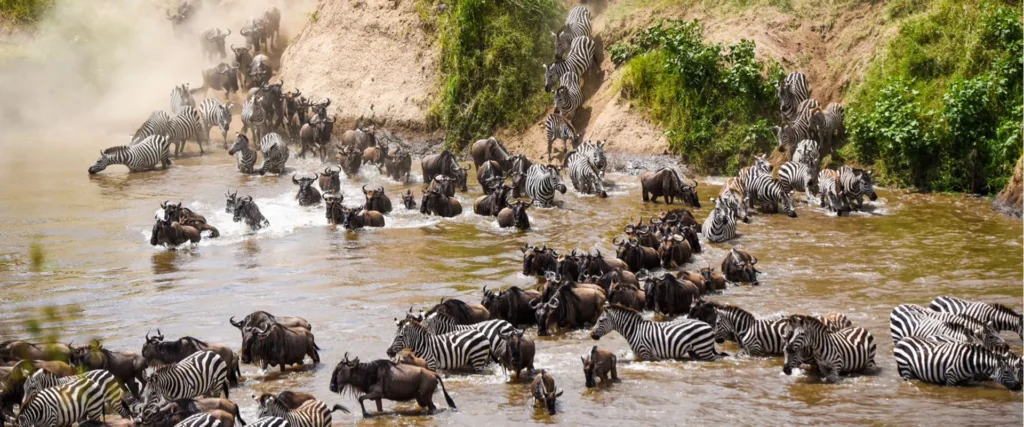
The ground shakes before you actually see the source of the commotion. It sounds like distant thunder, yet the sky above Kenya is clear; the rumble comes from over a million hooves pounding the dry earth as they approach the water’s edge. This is the visceral reality of Mara river crossings, a life-and-death spectacle that sits at the top of nearly every wildlife enthusiast’s bucket list, promising a front-row seat to nature’s most dramatic bottleneck.
While eager travelers often search for exact arrival times, the herds ignore printed itineraries in favor of survival instincts. The Maasai Mara migration is driven entirely by ancient rainfall patterns, creating a biological response that pushes roughly 1.5 million wildebeest and zebra northward in search of fresh grazing. Historical weather data confirms that the animals act as rain-chasers; if the rains are late, the herds stall, transforming the event from a scheduled appointment into a suspenseful, fluid phenomenon.
Despite nature’s unpredictability, a reliable timeframe does exist to help maximize your odds of success. Guides and safari experts generally identify the prime Maasai Mara river crossing dates as falling within a specific window from July through October. This four-month span offers the highest probability of witnessing the drama unfold, though seeing the actual plunge requires a mix of careful timing and the patience to wait alongside the crocodiles.
How the Fuel-Rain Cycle Dictates the Great Migration
Hunger is the primary motivation for millions of animals risking their lives in crocodile-infested waters. The Great Migration is essentially an endless search for fuel. Wildebeest are biological lawnmowers, requiring massive amounts of nutrient-rich grass to survive and nurse their calves. They aren’t wandering aimlessly; they are strictly chasing the rain. When the skies open up, fresh green shoots appear within days, acting as a magnetic pull for the herds. They simply have no choice but to follow the food source.
Nature dictates the itinerary through these localized weather patterns. Specifically, the herds track phosphorus-rich grass that blooms after storms. If the southern Serengeti dries out, they push north toward the wetter Maasai Mara migration grounds. However, this reliance on weather means the schedule is fluid. A delay in the seasonal rains can cause the herds to stall in Tanzania, waiting for the signal to move. This variability explains the short rains impact on herd movement; the grass growth decides if the crossing happens in July or is delayed until August.
Survival adds another layer to this movement. The herds must constantly seek ground where the grass is short enough to spot stalking lions, forcing them to keep moving to outpace predators. This constant, circular motion creates a rhythm that defines the ecosystem. While the “fuel-rain” dynamic explains the why, visualizing their path explains the where. To predict their location during your trip, it helps to picture the ecosystem as a giant clock face.
Using the Clock Face Analogy to Predict Herd Movement
Visualizing the Greater Serengeti-Mara ecosystem as a giant clock simplifies this 1,800-mile odyssey. The herds move in a roughly clockwise circle, driven by the seasonal rains described earlier. While the boundaries between Tanzania and Kenya are political lines on a map, the animals see only a contiguous landscape of grass. This circular visual simplifies the complex Serengeti to Maasai Mara migration route map, helping you understand exactly where the action takes place relative to the time of year.
The herds spend different seasons at specific “hours” on this ecological dial. A simplified breakdown helps clarify the timing:
- 6 o’clock (January–March): The herds congregate in the Southern Serengeti for calving season.
- 9 o’clock (April–June): The trek north begins through the Western Corridor (the “Grumeti”).
- 12 o’clock (July–October): The peak destination—Kenya’s Maasai Mara and the famous river crossings.
- 3 o’clock (November–December): The herds loop back south through the Eastern Serengeti as the short rains begin.
Reaching the 12 o’clock position is the climax of the journey. This northern tip represents the dry season refuge, where the Mara River provides the only permanent water source left. Travelers focused on the wildebeest migration calendar by month often target this window specifically for the high-drama river crossings. While the herds may arrive at the border as early as late June, the density required for spectacular viewing usually peaks shortly after, making the start of the dry season the critical time to watch.
Why July Offers the Best Odds for Crowd-Free Crossing Sightings
As the calendar turns to mid-July, the first wave of the mega-herd begins pressing into the northern extremities of the ecosystem. This period marks the arrival of the vanguard, the pioneering animals that reach the river ahead of the main column. While many travelers assume the action is instantly visible throughout the reserve, the migration actually spills into the area gradually. This early window offers a unique opportunity to witness the initial, tentative movements as wildebeest test the waters literally and figuratively seeking the lush grazing that signals their survival.
Geographically, the herds hit the Northern Serengeti first, an area known as Kogatende. This region acts as a critical staging ground where animals mass along the riverbanks, often waiting days before attempting a swim. The dynamic of Kogatende versus Maasai Mara river crossings is vital here; the animals don’t recognize the political border, so they often cross back and forth between Tanzania and Kenya in confusion. This results in high-drama moments on the southern banks before the bulk of the population officially enters Kenya.
Timing your trip for this early arrival phase rewards you with significantly fewer vehicles than the frenetic weeks that follow. While determining the best time to see the Great Migration in Kenya often leads crowds to August, July travelers trade the guarantee of massive density for the privilege of exclusivity. You might have to wait longer for a crossing, but you likely won’t be fighting fifty other jeeps for the view, allowing for a far more intimate connection with the wild.
Why August is the Peak Season for High-Drama Crossing Sightings
By the time August arrives, the trickle of wildebeest has turned into a flood, transforming the golden plains into a sea of moving black specks. This is widely considered the peak season for migration sightings because the bulk of the 1.5 million animals has officially entered the Maasai Mara. The “staging” phase of July is over; the ecosystem is now fully saturated, and the grass is disappearing fast, forcing the animals into constant motion.
This density creates a pressure-cooker effect that drives the drama. With so many mouths competing for limited food, the herds cannot stay still. They are forced to brave the Mara River crossings repeatedly, often swimming back and forth across the crocodile-infested water in a desperate search for fresh grazing. Unlike the tentative scouts of early summer, the herds in August are driven by urgency, leading to the frantic, massive plunges that define the Great Migration.
Travelers seeking this ultimate spectacle should prepare for a high-intensity environment that delivers specific realities:
- Reliable Action: With animals crowded along the banks, your chances of witnessing a crossing upgrade from “possible” to “highly probable.”
- Increased Dust: The dry season is at its height, and millions of hooves churn the soil into fine powder that coats everything, creating dramatic sunsets but requiring camera protection.
- Predator Activity: The high concentration of prey draws lions and crocodiles into a frenzy, offering frequent opportunities to see the raw reality of the food chain.
Once this chaotic peak passes, the dynamics of the herd shift yet again. The frantic desperation begins to cool as the animals spread out across the reserve, paving the way for the more settled grazing patterns that emerge in September.
How September Provides More Predictable Migration Patterns
As the frantic energy of August subsides, the Maasai Mara migration settles into a rhythm that is often more rewarding for patient observers. The herds haven’t stopped moving; instead of a singular northward push, they now engage in constant “back-and-forth” secondary crossings. Driven by localized rain showers that green up different pockets of the reserve, groups of wildebeest and zebra will brave the river multiple times, moving between the Mara Triangle and the Greater Mara in a continuous loop that keeps the riverbanks active well into the month.
Photographers often prefer this window because the visual conditions improve significantly. The choking dust clouds typical of the peak arrival begin to dissipate, offering clearer air and softer light for capturing the drama. Furthermore, because millions of animals have been grazing for weeks, the grass is now cropped short, removing the hiding spots for lions and cheetahs. This lack of cover turns the plains into an open stage where predator-prey interactions are visible from much greater distances, rather than being obscured by tall vegetation.
Knowing the average duration of the crossing period helps manage travel expectations, as this localized movement typically remains reliable through late September. The herds are essentially biding their time, fattening up on the nutrient-rich Mara grass while waiting for the weather to turn. However, this stability is temporary; as the clouds begin to gather in the south, the instincts that hold them here will soon be overridden by the scent of the approaching “Short Rains” in October.
How the Short Rains Trigger the October Return Migration
Just as the herds seem to have settled permanently into the Maasai Mara, the sky delivers a signal that changes everything. By late October, distinct storm clouds begin building on the southern horizon over Tanzania, marking the arrival of the “Short Rains.” This weather shift acts as a biological command for the wildebeest; their instinct to follow the rain is so powerful that they can seemingly smell the moisture and the promise of fresh grass sprouting hundreds of miles away in the Serengeti. The static grazing period ends abruptly, replaced by a renewed, frantic energy to move south.
Leaving the reserve isn’t as simple as walking away, however, because the Mara River often snakes between the herds and their destination. Consequently, late October offers “exit crossings” that rival the drama of the initial arrival in July. The motivation is now twofold: the animals are pulled forward by the scent of rain and pushed from behind by a landscape that has been grazed to the dirt. With the Mara’s resources exhausted, the herds must brave the crocodile-filled waters one last time to survive, often piling up on the northern banks before making the plunge.
Travelers visiting during this shoulder season witness a stark and sudden transformation. You might encounter spectacular final river crossings amidst dramatic afternoon thunderstorms, but the landscape empties rapidly. Once the decision to leave is made, the “mega-herd” vanishes south within days, leaving the plains eerily quiet. To catch these final, high-stakes moments before the stage clears, you need to know exactly where the river bends create natural bottlenecks.
Navigating the Mara River Crossing Points for Maximum Sighting Odds
Seeing a crossing isn’t just about reaching the riverbank; it is about being at the right part of the river. The Mara winds like a snake through the reserve, creating distinct “stages” where the drama plays out differently depending on the landscape. Your guide knows that wildebeest are creatures of habit who return to specific entry points year after year, but the herd’s choice on any given day depends heavily on the physical difficulty of the terrain.
Topography dictates the speed and intensity of the event. Gentle, shallow banks often encourage a calm, steady stream of animals walking across, which is easier to watch but less chaotic. In contrast, steep, cliff-like banks force the herds to leap blindly into the water or scramble frantically up vertical walls on the other side. These high-risk zones create the panic often seen in documentaries, resulting in animals piling up as they struggle against the current and the slick mud.
While there are over a dozen potential entry zones, veteran guides prioritize four legendary sites to maximize your chances:
- Lookout Hill: Offers a high panoramic view where you can see herds gathering from miles away.
- Main Crossing: The most famous site, delivering high-volume movement often visible from multiple angles.
- Paradise Plain: Known for dramatic steep banks and typically high crocodile activity.
- Cul-de-Sac: A classic bend where the river loops, often forcing herds to cross twice in quick succession.
Aligning your location with the type of scene you hope to witness allows for better preparation. Distinct terrain matters: shallow crossings offer wide, panoramic shots of the line, while steep banks provide action shots of leaps and splashes. However, simply parking at a famous spot doesn’t guarantee immediate action, as the herds often engage in a complex psychological dance before touching the water.
Why Herd Behavior Before a Crossing Requires Safari Patience
Arriving at a prime riverbank location often leads to a confusing scene: thousands of wildebeest standing completely still, staring at the water but refusing to move. This phenomenon, known as “staging,” is a period of intense hesitation where the herd accumulates numbers and assesses threats. Rather than a mindless stampede, the migration herd behavior before crossing involves a complex risk assessment that can last for hours or even days. The animals crowd the edge, seemingly ready to go, only to turn back and graze again if a shadow moves or the wind shifts, testing the patience of even the most dedicated observers.
Breaking this deadlock requires a single catalyst to override the collective fear. The group operates on a “safety in numbers” instinct, waiting for one brave or unlucky individual to take the first plunge. Once that lead animal commits to the current, the tension snaps instantly, replaced by a frantic drive to follow the leader. This psychological switch explains why a quiet riverbank can transform into a chaotic frenzy in seconds; the herd knows that their survival odds increase dramatically if they overwhelm the river all at once, meaning no animal wants to be left behind on the bank.
Mastering the art of the wait is the hardest part of a safari, but leaving the site prematurely is a common mistake. Veteran guides look for subtle cues, such as increased vocalization or shoving at the front lines, which suggest the stalemate is about to end. While the average duration of the crossing period itself might only be twenty minutes of intense action, the visual payoff is worth the hours of anticipation. Unfortunately, the herds aren’t the only ones watching the water; lurking beneath the brown surface, massive reptiles have also been calculating the exact moment to strike.
How Nile Crocodiles Shape the Strategy of a Wildebeest Crossing
Beneath the murky waters of the Mara River, the residents have been fasting for months in anticipation of this exact moment. Nile crocodile activity during migration season peaks specifically when the herds arrive, as these massive reptiles rely on the annual influx of protein to sustain them for the rest of the year. Unlike the high-speed chase of a lion on the plains, crocodiles utilize patience and camouflage, drifting like logs until the water is disturbed. This silent threat is the primary reason the herds hesitate on the banks; they aren’t just looking for a manageable exit point, but scanning for the slightest ripple that betrays a waiting ambush.
Once the first animal leaps, the collective strategy shifts from caution to overwhelming force. The migration river crossing survival challenges are met with sheer volume, as thousands of animals splash into the river simultaneously to confuse the predators. It is a grim numbers game where the herd accepts that some individuals will be taken so the majority can pass safely. The ensuing chaos churns the water into a frenzy, blinding the predators and preventing them from targeting specific animals easily. This “flood the zone” tactic is the wildebeest’s only effective defense against a bite force that can crush bone instantly.
Surviving the gauntlet is physically exhausting, leaving the animals wet and vulnerable as they scramble up the slippery far bank. For the observer, the collision of ancient reptile instinct and desperate mammalian drive creates scenes of raw power that are difficult to process in real-time. Witnessing this life-and-death struggle is the highlight of the safari, offering split-second moments of drama that demand sharp reflexes to capture effectively on camera.
How to Photograph a Wildebeest River Crossing Like a Pro
Capturing the sheer bedlam of the riverbank requires preparation, not just luck. As thousands of animals hit the water, they kick up a “Golden Dust” that filters the light but can easily confuse your camera’s autofocus systems. Instead of trying to chase every splash, observe the herd behavior before crossing to predict where the main column will break the surface. You need to be shooting continuously, as the difference between a blurry hoof and a dramatic, suspended leap is often a fraction of a second.
To ensure you walk away with sharp images rather than motion-blurred disappointments, shift your camera out of “Auto” mode. You need speed above all else to handle the rapid movement against the river current.
- Shutter Speed: Minimum 1/1000th of a second to freeze water droplets and muscle tension.
- Aperture: f/5.6 or f/8 to keep multiple animals in focus rather than just one nose.
- Focus Mode: Continuous Servo (AI-Servo or AF-C) to track moving subjects automatically.
Where you park is just as critical as your settings. While the plunge is dramatic, knowing how to photograph a wildebeest river crossing effectively often involves positioning your vehicle near the exit point on the far bank. The most emotional shots frequently happen here, capturing the wet, exhausted survivors scrambling up the slippery mud walls. This strategy generally puts the sun behind you, illuminating the subject, though you must always be ready for how quickly the light changes when the afternoon clouds roll in.
Preparing for Safari Weather Conditions in July and August
While many imagine the savannah is permanently scorching, safari weather conditions in July and August are deceptive. You will likely wake up shivering, as Mara mornings often drop below 50°F (10°C). The best strategy is a “three-layer” approach: start with a heavy fleece for the open-sided vehicle, then peel down to a t-shirt as the equatorial sun takes over by midday. Ignoring this thermal shift can leave you distracted by the cold exactly when predators are most active.
Beyond temperature, the environment demands specific gear. Since the prime Maasai Mara river crossing dates fall during the driest months, fine dust coats everything within minutes. Wearing neutral khaki isn’t just a cliché; it hides the red dirt better than white, while dark colors often attract painful tsetse flies. Even with the right clothing, minimizing the travel time between the dusty plains and your camp becomes the ultimate comfort factor.
Why Migration Safari Accommodation Near the River is Worth the Premium
Securing migration safari accommodation near the river often costs significantly more than lodges on the park’s periphery, but you are essentially paying for time, not just luxury. During the peak crossing dates, the most dramatic activity frequently occurs in the cool hours of early morning or late afternoon. Travelers staying outside the reserve often face a two-hour bone-rattling “commute” just to reach the water, risking the frustration of arriving moments after the herds have already scrambled up the banks.
Being positioned within the Mara Triangle or immediate riverfront conservancies transforms the experience from a frantic chase into a strategic wait. This proximity allows you to reach prime viewing spots before the midday heat creates shimmering hazes that ruin photography, or easily retreat to camp for lunch while the herds stagnate. However, even the most expensive tent with a front-row seat cannot force the wildebeest to move, leading to the inevitable challenge of managing expectations when the savannah falls silent.
Managing Expectations: What to Do When the Herds Are Silent
Even with a front-row seat, nature refuses to follow a script. It is common to watch thousands of animals gather at the water’s edge only to retreat due to a sudden breeze, meaning herd behavior before crossing is often defined by extreme caution and false starts. Rather than viewing this stillness as wasted time, recognize the electric atmosphere as the necessary suspense before the main event.
Silence on the riverbank rarely implies the ecosystem is asleep. While herds hesitate, resident lions are often actively positioning themselves, offering predator sightings that define the Maasai Mara migration just as much as the river jump. A quiet day where pressure builds is frequently the precursor to an explosive morning where the dam finally breaks.
Your Step-by-Step Action Plan for a Migration Safari
You no longer need to rely on luck to witness nature’s greatest drama; you simply need to align your travel with the dry season’s rhythm. To turn the unpredictable Maasai Mara river crossing dates into a concrete itinerary, follow this strategic roadmap:
- Book riverfront lodges 12 months in advance.
- Target the prime July to October window.
- Select a camp located inside the Mara Triangle or near the Talek.
- Prioritize a private vehicle and expert guide.
- Prepare mentally for long days of waiting by the riverbank.
The logistics are just the gateway to the magic. When the planning fades and you finally hear that guttural bellow echoing across the savanna the sound of a million lives in motion you will understand exactly why this is the best time to see the Great Migration in Kenya.