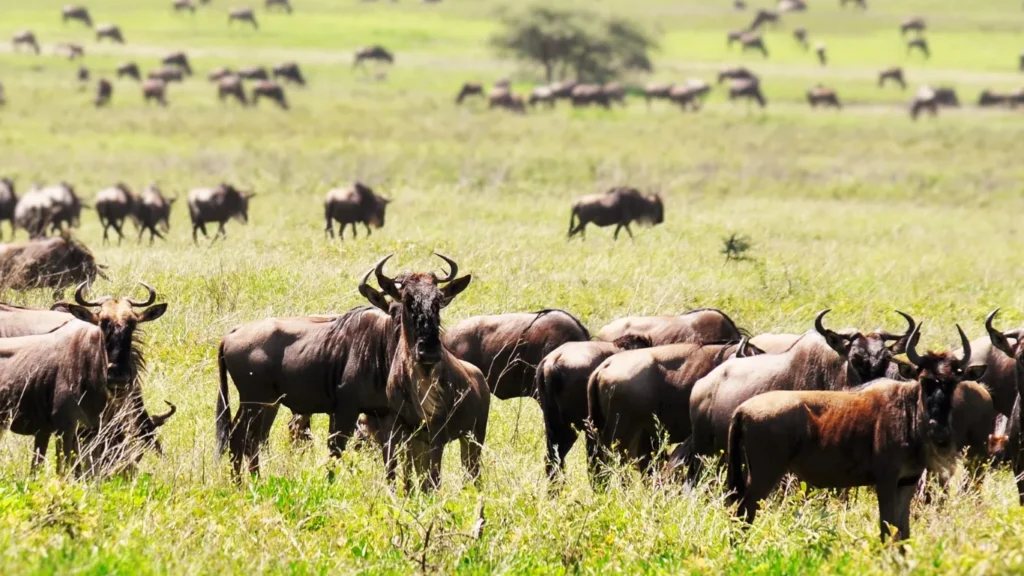
Imagine the savanna floor vibrating as 1.5 million hooves thunder across the plains. This phenomenon isn’t a race with a finish line; naturalists describe the Great Migration Kenya hosts as a giant, biological clock driven by the scent of rain. During the Kenya animal migration season, vast herds follow this continuous loop in a desperate survival instinct to find fresh grazing, proving that for these animals, movement is the only way to stay alive.
The ‘Lawnmower Effect’: Why Zebras and Wildebeests Team Up for Survival
Survival isn’t just about calories; it is a desperate search for chemistry. The immense herds aren’t wandering aimlessly they are chasing phosphorus, a mineral essential for bone growth and milk production. As heavy rains hit volcanic soils, they unlock a nutrient boom that draws the animals forward like a magnet. This chemical craving is a primary ecological impact of the great wildebeest migration, forcing over a million bodies to continuously churn the soil in pursuit of mineral-rich grazing lands.
To make this journey efficient, what animals move during the great migration matters just as much as where they go. They rely on the “Lawnmower Effect,” a grazing strategy that prevents competition:
- Zebras: Act as the heavy machinery, eating the tall, tough, low-nutrient grass tops.
- Wildebeests: Follow behind to graze the nutritious middle layer exposed by the zebras.
- Gazelles: Arrive last to nibble the tender, protein-rich shoots close to the ground.
With their energy reserves topped up by this efficient system, the herds must next face their most dangerous obstacle yet: the river.
Timing the Mara River Crossing: When High Stakes Meet High Rewards
By late June, the southern grasses have turned to dust, driving the herds north into Kenya’s Maasai Mara. This period marks the best time for Maasai Mara safari viewing, as the migration funnels nearly two million animals toward the steep banks of the river system. Travelers asking when do wildebeest cross the Mara River should generally target the window between late July and October, though the specific timing relies entirely on the scent of rain rather than a fixed calendar schedule.
Staring into the churning water, the herds face a critical biological calculation: the immediate danger of crocodile ambush versus the slow death of starvation. This standoff highlights the brutal predator-prey dynamics in the Maasai Mara, where the “reward” of lush grazing on the opposite bank outweighs the immense “risk” of the crossing. Once the first animal leaps, the hesitation breaks, creating a chaotic spectacle that draws thousands of human observers, making strategic planning essential to see the event without getting lost in the crowd.
How to Witness the Migration Without the Crowds
The desperate rhythm driving the herds transforms the savanna into a stage of survival. To translate this insight into a journey, follow this plan on how to book a migration safari in Kenya:
- Target the ‘shoulder’ months of late June or October.
- Choose conservancies over the main reserve for avoiding crowds during peak safari season.
- Book at least 8-12 months in advance for luxury tented camps near migration routes.
Your planning ensures you respect the herd’s survival, witnessing the wild exactly as it should be—untamed and enduring.