Imagine a gemstone so rare that the world’s entire supply originates from a single patch of earth just four kilometers long. While diamonds are mined on almost every continent, genuine Tanzanite is found exclusively in the Merelani Hills mining region near Mount Kilimanjaro. Geologists describe this formation as a “geological miracle,” noting that the specific volcanic conditions required to create this stone exist nowhere else on the planet.
Because of this extreme isolation, industry experts often call it the “stone of a single generation,” warning that current mines could be depleted within the next few decades. This scarcity elevates the mineral scientifically known as blue zoisite. Its unique crystal properties create a visual depth that rivals the finest sapphires, offering a fleeting opportunity to own a piece of disappearing natural history.
From Lightning Strikes to Luxury: The Story of a Modern Miracle
Legends say it took a bolt of lightning setting the Mererani Hills on fire to reveal these blue treasures to Maasai tribesmen in 1967. Before that natural heat treatment, the crystals were largely brown rocks blending into the earth. When the smoke cleared, local herders stumbled upon the newly transformed, vivid blue gems, sparking a “gem rush” at the foot of Mount Kilimanjaro that eventually caught the eye of New York’s luxury elite.
Although the stone was visually stunning, its scientific name—Blue Zoisite—was a marketing nightmare. Henry B. Platt of Tiffany & Co. famously felt the name sounded far too much like “suicide,” so he rebranded the gem to honor its exclusive country of origin. This pivotal decision in 1968 turned a mineralogical curiosity into a global obsession almost overnight.
That meteoric rise culminated in the gem joining the exclusive roster of birthstones, a feat that usually takes centuries of tradition to achieve:
- 1967: Maasai herders discover the crystals near Mount Kilimanjaro.
- 1968: Tiffany & Co. launches a massive campaign, officially christening the stone “Tanzanite.”
- 2002: The jewelry industry adds it as a December birthstone, the first update to the list in nearly 90 years.
With its history established, the real visual magic lies in the stone’s ability to shift colors right before your eyes.
The ‘Chameleon’ Gemstone: Mastering the Magic of Pleochroism
Hold a fine Tanzanite up to the light, and you will witness a rare optical phenomenon called pleochroism. Much like a hologram that shifts as you move it, this gem displays three different colors—blue, violet, and burgundy—depending on the angle of view. Beneath its glamour, the gem has a unique calcium aluminium silicate hydroxide composition, a complex crystal structure that splits light beams to create this mesmerizing, shifting palette.
To unlock the permanent blue-violet hue we recognize today, gem cutters almost always use a controlled heat treatment. Because the gem usually emerges from the earth as a brownish crystal, jewelers use ovens to gently replicate the geological heat that first created the stone. This standard industry process drives away the muddy, reddish-brown tones without damaging the structure, essentially “finishing” what nature started to reveal the vivid colors hidden inside.
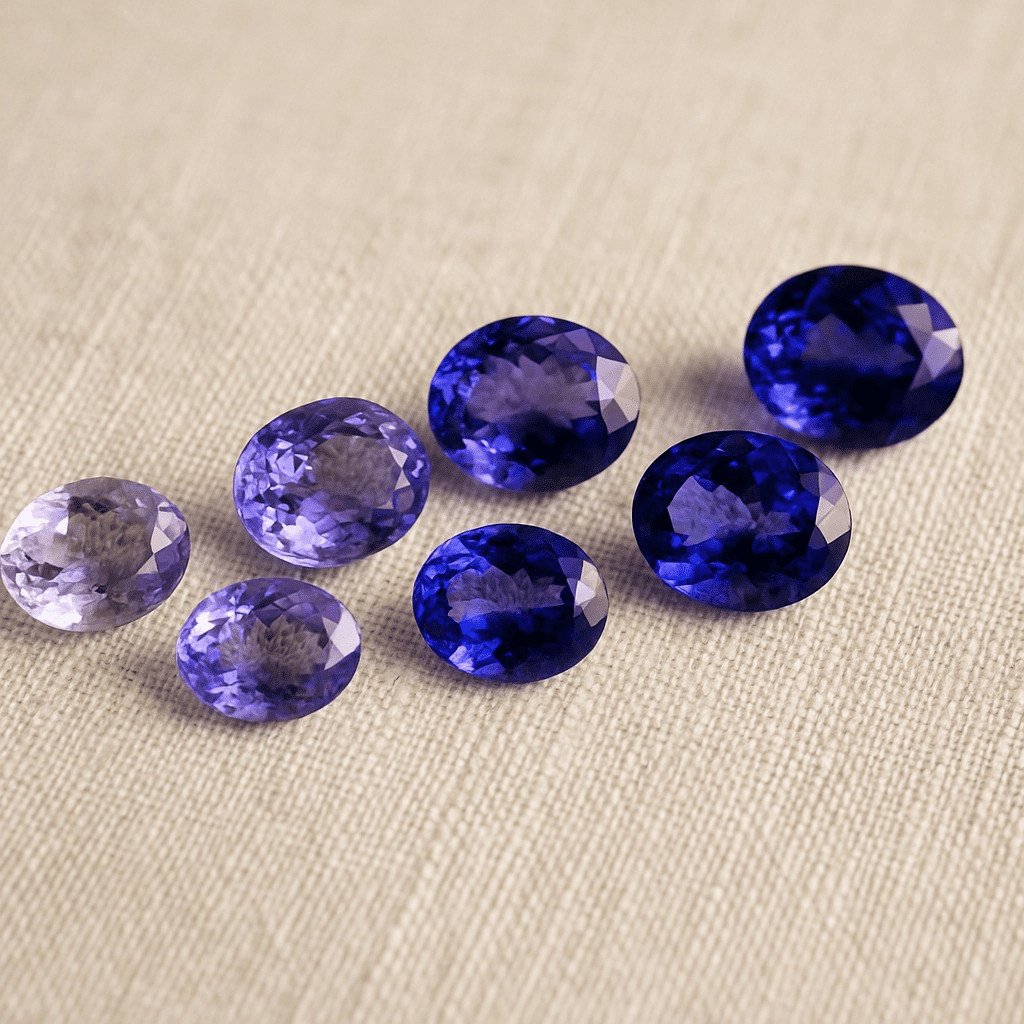
Assessing the quality of that final color is where the real value lies. While lighter, lilac-colored stones are common and affordable, the most prized examples display a deep, saturated “velvet” blue with flashes of royal purple. This intensity indicates a larger, higher-quality crystal that commands a premium price. Recognizing the difference between a pale lavender souvenir and a rich, investment-grade gem is the first step toward making a smart purchase.
Buying Like a Pro: How to Spot an Heirloom-Quality Stone
While carat weight often steals the spotlight, color intensity is the true driver of value. When analyzing blue sapphire vs violet gemstone price differences, you will find that commercial-grade Tanzanites often look like pale lavender glass, while heirloom-quality pieces exhibit a deep, saturated royal blue that holds its color even from across the room. To avoid overpaying, look for that signature “velvet” depth rather than a washed-out lilac tone; a smaller, intensely colored stone is almost always a better investment than a large, pale one.
Once you have confirmed the color, look closely for clarity. Unlike emeralds, which are expected to have internal flaws, Tanzanite should be “eye-clean”—meaning no spots or cracks are visible without a microscope. Evaluating clarity and saturation becomes simple when you demand these “Top 3” traits for gemstone grading for investment quality:
- Deep Saturation (AAA): Vivid indigo or violet, never pale.
- Eye-Clean Clarity: Zero visible inclusions blocking the light return.
- Master Cutting: Symmetrical facets that eliminate dark “window” gaps in the center.
Securing a stone of this caliber is a triumph, but maintaining it requires specific care for a gem that is slightly softer than sapphire.
Protecting Your Sparkle: How to Wear and Clean a Stone Softer Than Sapphire
Although a diamond is forever, Tanzanite requires a bit more situational awareness to survive daily life. On the Mohs scale of mineral hardness ranking, this gem sits between 6 and 7, meaning it is significantly softer than a sapphire and can be scratched by household dust or knocked against hard surfaces. If you plan to wear a ring daily, choosing the right setting for ring durability is crucial; a bezel setting, which wraps metal entirely around the stone’s perimeter like a protective rim, offers far more security than exposed prongs that leave edges vulnerable to chipping.
When the sparkle eventually fades due to lotions or dust, resist the urge to use the ultrasonic machines found at jewelry counters, as their high-frequency vibrations can shatter this stone’s internal structure. Instead, rely on safe cleaning methods for delicate jewelry that you can perform at home:
- Mix warm water with a small drop of mild dish soap.
- Gently scrub behind the stone and around the setting with a soft-bristled toothbrush.
- Rinse with lukewarm water and pat dry with a lint-free cloth.
Preserving the condition of your stone is about more than just maintaining its beauty; it is an act of conservation. Since the world’s only supply is rapidly depleting, keeping your gem intact preserves a fragment of geological history that may soon be impossible to replace.
The Last of Its Kind: Owning a Piece of Earth’s Finite History
Tanzanite is more than just a beautiful accessory; it is a fleeting geological miracle. The unique geological conditions of the Manyara Region created a finite treasure expected to be mined out in mere decades. Acknowledging this scarcity transforms a potential purchase from a simple transaction into the preservation of a vanishing fragment of Earth’s history.
Approach the jewelry counter with the confidence of an insider. Look for that signature violet flash and prioritize deep saturation over sheer size to ensure true value. Whether you are selecting a future heirloom or simply admiring a display, appreciating the specific magic of this gem makes it a legacy worth holding.