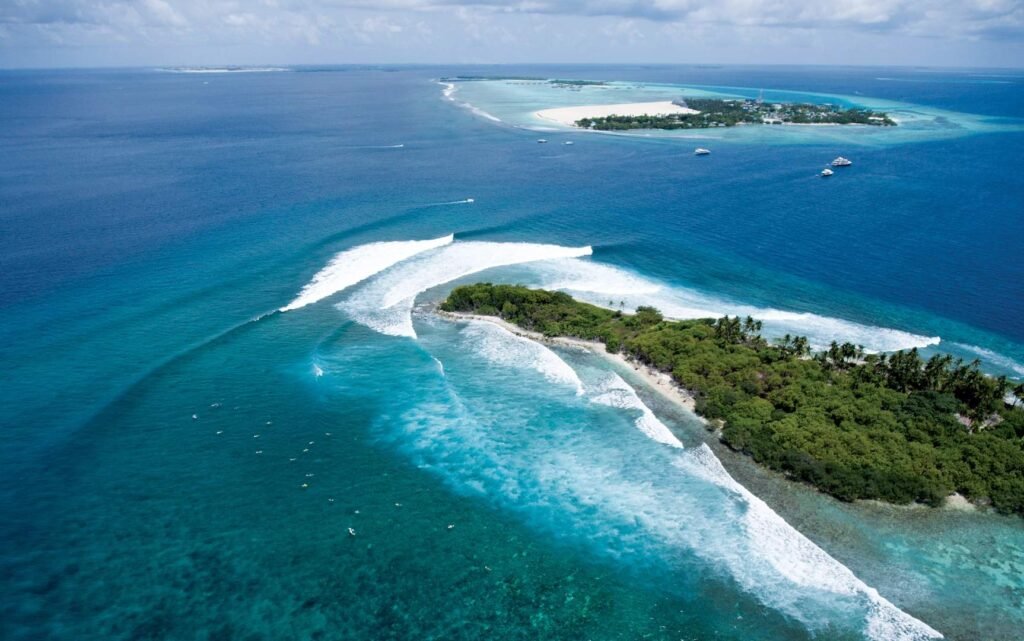
While the Pacific operates as the planet’s giant and the Atlantic serves as the great bridge between worlds, the Indian Ocean operates as the Earth’s hidden engine room. It is the only ocean named after a single nation, yet its influence stretches far beyond any one border to affect the lives of billions. Covering nearly 20% of the Earth’s water surface, this vast body of water is frequently overlooked in favor of its larger siblings, but geographers and climate scientists recognize it as a critical force in keeping our world habitable.
Unlike the Atlantic or Pacific, which stretch continuously from the icy Arctic in the north to the Antarctic in the south, the Indian Ocean possesses a distinct geographic personality. Physically blocked—or “closed”—to the north by the massive Asian continent, the ocean cannot vent its heat into the freezing Arctic waters. Consequently, it retains heat unlike any other marine system, making it the warmest ocean on the planet.
That trapped warmth transforms the water into a massive thermal battery for the global climate. The Indian Ocean absorbs immense amounts of solar energy and acts as a distributor, regulating temperatures far beyond its shorelines. It functions less like a stagnant pool and more like a beating heart, pumping heat and moisture into the atmosphere to drive weather systems that sustain agriculture and life across Africa, Asia, and Australia.
This dynamic system changes how we view the map. While travel brochures might focus on the turquoise shallows of the Maldives or the white sands of Seychelles, the real story lies in the deep, warm currents moving silently beneath the surface. By exploring how this “closed” ocean operates, we can begin to see why it serves as a critical hotspot for the planet’s future, influencing everything from the rain that falls on our crops to the global weather influence that defines our seasons.
The ‘Closed’ Ocean: Why Its Unique Map Controls Global Weather
Among the globe’s blue spaces, the Indian Ocean stands out because of what it lacks. Unlike the Atlantic or Pacific, which stretch continuously from pole to pole, this body of water is firmly capped to the north by the massive Asian continent. It forms a giant, inverted “Y” shape: while the southern edge opens widely to Antarctica, the northern sections are blocked by land, with India jutting down like a wedge into the center.
This geographical dead end creates a unique “heat trap.” In other oceans, cold currents flow down from the Arctic to mix with tropical waters, acting much like a cold tap running into a warm bath to regulate the temperature. Here, that cooling valve is missing. Without icy northern inputs to temper the sun’s energy, the Indian Ocean remains exceptionally warm year-round.
Stored energy eventually drives the region’s atmospheric engine. The sharp temperature contrast between the hot land and the warm sea creates a pressure imbalance found nowhere else. This setup acts as the trigger for the next massive shift: the life-giving breathing cycle known as the Monsoon.
How the Monsoon ‘Breathes’ Twice a Year
The Asian continent acts like a massive set of lungs. As summer arrives, the land heats up much faster than the water—much like scorching sand compared to the surf. This intense heat causes air over the continent to rise, creating a vacuum that pulls in moisture-heavy wind from the sea. This is the “inhale,” a wet wind that dumps torrential rains across India and Southeast Asia, turning dry earth into green farmland almost overnight.
Come winter, the mechanism reverses completely. Since deep water holds onto heat longer than soil does, the ocean stays warm while the land rapidly cools down. The warmer air now rises over the sea instead, causing the continent to “exhale” dry, cool air back out. This complete 180-degree wind shift is the true scientific definition of a monsoon; it isn’t just a heavy rainstorm, but a seasonal U-turn of the atmosphere itself.
For two billion people, this atmospheric heartbeat determines survival. The summer rains act as the world’s largest free irrigation system, growing the crops that feed nearly a third of the global population. However, this rhythm isn’t always perfect. Much like the Pacific has El Niño, the Indian Ocean has its own temperamental climate swing, a phenomenon called the Dipole that can disrupt this delicate balance.
El Niño’s Cousin: The Indian Ocean Dipole and Your Local Weather
While El Niño in the Pacific is well known, the Indian Ocean hides a similar, powerful engine called the Indian Ocean Dipole (IOD). This functions as a massive thermal seesaw stretching across the equator. Instead of temperatures staying uniform, an ocean temperature oscillation occurs where warm water pools on one side of the basin while cool water rises on the other. This creates a “dipole,” or two distinct poles of climate variability, acting like a massive atmospheric switch. When the warm water sloshes toward the western side, it fundamentally changes the air pressure above, driving weather patterns that can reach halfway around the globe.
The consequences of this shifting balance are often extreme. During a “positive” phase, warmer waters near Africa trigger heavy rains and flooding there, while the cooler waters near Indonesia and Australia suck moisture from the air, leading to severe droughts and bushfires. A “negative” phase flips the script, drenching Australia while potentially drying out East Africa. Yet, while these tropical dipole climate patterns dictate the weather above the waves, an entirely different world exists far below, where the ocean floor plunges into extreme darkness at the Java Trench.
The Java Trench: Journeying to the Bottom of the Earth’s Moving Floor
Even if you could flip Mount Everest upside down and place it into the ocean south of Java, the mountain’s peak would still fail to break the surface. This terraced abyss is the Java Trench, the Indian Ocean’s deepest point, where the seabed plunges into total darkness. Unlike the calm, sandy shallows of the Maldives, this trench represents the ocean’s geologically violent edge, curving like a scar along the Indonesian coastline.
The existence of such a deep chasm is due to a geological process happening in slow motion. This area serves as a major subduction zone, where the heavy Indo-Australian Plate grinds against and slides beneath the lighter Eurasian Plate. Like a conveyor belt disappearing under a floorboard, as the oceanic plate dives down, it drags the seafloor with it, creating a V-shaped canyon and generating the friction that fuels the region’s notorious earthquakes and tsunamis.
Key dimensions define this hidden frontier:
- Depth: Reaching roughly 7,290 meters (24,000 feet), it is the lowest point in the entire basin.
- Length: The chasm stretches about 3,200 kilometers (2,000 miles) along the Sunda Arc.
- Speed: The tectonic plates converge here at a rate of roughly 6 centimeters per year.
While tectonic forces shape the ocean floor, a different kind of chemistry war shapes the surface waters to the north.
Bay of Bengal vs. Arabian Sea: Why One Side is Saltier and Stormier
The Indian peninsula splits the ocean’s north into two distinct arms: the Arabian Sea to the west and the Bay of Bengal to the east. While they appear identical, a hidden chemistry war makes them opposites. The Arabian Sea, bordered by parched deserts, acts like a giant evaporation pan where heat creates heavy, salty water that sinks. Conversely, the Bay of Bengal is constantly flooded by massive rivers like the Ganges, which pour freshwater into the basin. This runoff creates distinct salinity levels, forming a lighter, fresh layer that floats on top of the dense salt water like oil on vinegar.
This aquatic layering has volatile consequences. Because the fresh “lid” prevents the surface water from mixing with the cold depths, heat gets trapped at the top, providing high-octane fuel for cyclone formation. This dynamic explains the Bay of Bengal vs Arabian Sea difference: the eastern side is a storm breeding ground, while the salty western side remains more stable. Long before meteorologists understood this science, mariners mastered these winds, using the predictable currents to build a legendary network of trade.
The Original Information Superhighway: Lessons from the Ancient Silk Road
Long before the internet, the Indian Ocean served as the world’s first information superhighway. While the Atlantic acted as a barrier to early civilizations, this ocean functioned as a bridge because of the reliable Monsoon winds. Merchants realized they could ride the gusts toward India in summer and drift back to Africa in winter, creating the predictable schedule of ancient maritime silk road history.
The vehicle for this commerce was the Dhow ship, a vessel with a distinctive triangular sail designed to catch these seasonal breezes. These nimble wooden ships stitched together distant ports, carrying cinnamon from Sri Lanka and porcelain from China like a rhythmic conveyor belt. This system allowed diverse economies to rely on each other centuries before the term “globalization” existed.
Beyond material goods, this movement fostered a profound cultural exchange. Ideas and religions flowed across the water alongside cloves and gold, creating a cosmopolitan rim where a merchant in Zanzibar could connect with a trader in Gujarat. Today, wooden hulls have been replaced by steel giants, yet this waterway remains a modern juggernaut where our energy supplies must now squeeze through narrow gates.
The 80% Rule: Why Your Smartphone and Coffee Rely on Three ‘Chokepoints’
Electronics, clothes, or the fuel in our cars likely traveled across the Indian Ocean to reach our homes. While the open water is vast, the entrances and exits are surprisingly narrow. We call these strategic maritime trade routes “chokepoints” narrow channels where global shipping is forced to squeeze through like traffic merging into a single lane.
Three specific gates control the flow of the world’s economy:
- Strait of Hormuz: Located between Oman and Iran, this is the world’s most critical oil artery and is vital for global energy security.
- Strait of Malacca: The primary passage for manufactured goods, funneling items like iPhones and sneakers from East Asia to the rest of the world.
- Bab-el-Mandeb: The southern gateway to the Red Sea and Suez Canal, crucial for moving everyday products between Europe and Asia.
Because these lanes are so tight, a single blockage can ripple through the global economy, delaying deliveries and raising prices instantly. Yet, far removed from these congested commercial highways, this ocean hides a secret. Just south of the busy shipping lanes lies a sanctuary of silence and vibrant life known as the Chagos Archipelago.
Chagos Archipelago: A Glimpse into the World’s Most Pristine Biodiversity
Far from the hum of cargo ships, the Chagos Archipelago offers something rare: a living time capsule. Because this remote cluster of islands is strictly guarded as a massive Marine Protected Area (MPA) a designated zone where commercial fishing and mining are banned it serves as a crucial “ecological baseline.” Scientists flock to these waters not just to admire the view, but to observe what a healthy ocean looks like in its natural state. By studying a reef system that functions exactly as nature intended, researchers can better understand the damage occurring in more populated waters and set realistic goals for global recovery.
This extreme isolation creates a fortress for biodiversity. Without the pressure of industrial pollution or overfishing, the reefs here host the world’s densest concentration of giant brain corals, some growing as large as small cars. It is a vibrant, untouched underwater city that proves how resilient the ocean can be when left alone. While Chagos represents the ocean in its wildest, most protected form, another group of islands further west demonstrates how unique life can evolve when cut off from the rest of the world for millions of years.
The Seychelles Islands: How Isolation Created a Living Museum
Most tropical getaways are built on volcanic rock, but the inner Indian Ocean Seychelles islands are unique. These are actually ancient shards of a continent—massive granite boulders that broke off from India and Africa 75 million years ago. This geologic accident created a “living museum” completely cut off from the mainland, allowing life to evolve in strange, isolated directions.
This separation fostered endemic species nature found exclusively in one place. The prime example is the Coco de Mer palm, known for producing the world’s heaviest seed. Weighing as much as three bowling balls, these double-lobed nuts were once believed by sailors to grow in mythical underwater forests, fueling legends long before the actual trees were found on land.
On the islands, a lack of predators allowed the Aldabra giant tortoise to reach massive proportions, wandering the beaches like a living boulder. While these reptiles are confined to their granite fortress, the deep waters surrounding the archipelago act as a seasonal highway for the ocean’s true giant.
Following the Blue Whale: The Secret Migration Corridors
While most blue whales commute thousands of miles to the icy Antarctic to feast on krill, the Indian Ocean harbors a distinct rebel: the Pygmy Blue Whale. Despite the name, these animals still grow to the length of two school buses, but unlike their global cousins, many choose to stay in these tropical waters year-round. They rely on the ocean’s unique monsoon currents to churn up nutrients, allowing them to find abundant food sources without ever leaving the warmth of the equator.
Finding these resident giants in such a vast expanse requires listening rather than looking. Scientists deploy hydrophones specialized underwater microphones to intercept low-frequency calls that travel across the basin like a submerged radio signal. By tracking these unique vocal “dialects,” researchers can map the whales’ secret corridors through the deep without ever seeing them surface. Unfortunately, the data shows that these whales often remain dangerously close to warming surface waters, a habitat change that threatens them just as severely as the fragile reefs below.
Can We Save the Coral? Protecting Endangered Species from Warming Seas
The same tropical warmth that sustains resident whales is becoming a fever for the ocean’s architects. While often mistaken for colorful rocks, corals are actually colonies of tiny animals living in a tight partnership with microscopic algae. This symbiosis is the reef’s engine; the algae provide food and vibrant color, while the coral provides a safe home. However, the Indian Ocean’s status as the warmest ocean on Earth puts this delicate relationship on the front lines of climate change.
When water temperatures spike for too long, the coral gets stressed and expels its partners. This phenomenon, known as coral bleaching, unfolds in a tragic sequence:
- Ejection: Overheated coral expels the colorful algae to save energy.
- Ghosting: Without the algae, the coral turns stark white, looking like a skeleton.
- Starvation: If the water remains hot, the coral eventually starves and dies.
Fortunately, conservationists are fighting back by establishing Hope Spots, special regions critical to ocean health that receive heightened legal protection. These safe havens allow endangered coral reef species in places like the Maldives to recover from heatwaves without the added pressure of industrial fishing. Yet, even protected reefs face a suffocating threat that respects no boundaries, floating in on the currents from thousands of miles away.
The Tide of Plastic: How to Stop 1.3 Million Tons of Waste
While heat is an invisible killer, the next threat is unmistakably colorful and physical. Millions of tons of debris are currently trapped in the Indian Ocean Gyre, a massive circular current system that acts like a slow-moving whirlpool. Contrary to the popular myth of a solid floating island, this zone is actually a dense soup of microplastics that marine life frequently mistakes for food. This waste rarely starts at sea; instead, major waterways like the Ganges and Indus serve as the primary delivery arteries, continuously pumping urban trash directly into these swirling offshore currents.
Tackling this crisis requires managing our plastic footprint before the waste ever reaches the water. Simple shifts in daily habits, such as swapping disposable bottles for durable metal ones or choosing clothing made from natural fibers to reduce microfiber shedding, act as effective upstream filters for the ocean. Supporting initiatives that place physical barriers in river mouths also proves critical for interception. However, even if we scrub the water clean, the land itself faces a different kind of disappearance as rising seas eat away at the beaches.
Vanishing Shores: How Coastal Erosion Protection Actually Works
For nations like the Maldives, where the ground averages less than two meters above the tide, the ocean is literally knocking at the front door. Rising sea levels do not just submerge land; they bring stronger waves closer to shore, scrubbing away beaches and threatening the freshwater supplies of major coastal cities like Dhaka and Mumbai. This is not a distant future scenario but an active crisis requiring immediate, scalable defense.
Historically, engineers built rigid concrete seawalls, but these often backfire by reflecting wave energy, which scours the sand away from the wall’s own foundation. A more resilient strategy is soft engineering, where living barriers like mangroves and coral reefs are restored to mimic the coast’s natural armor. These tangled root systems function like massive shock absorbers, slowing the water down a process called coastal attenuation so that waves arrive at the beach as a gentle lap rather than a destructive crash.
Restoring these green belts offers a sustainable shield that is often cheaper than concrete, protecting millions of people while doubling as nurseries for local fisheries. Yet, while the battle to save the shoreline takes place in the sun, a controversial new industry is eyeing the pitch-black floor of the ocean, searching for wealth that has laid undisturbed for millennia.
Deep Sea Mining: Who Owns the Treasures of the Abyss?
Far below the waves, the Indian Ocean floor is scattered with what looks like millions of black potatoes. These are polymetallic nodules, rocky lumps packed with manganese, nickel, and cobalt that have formed over millions of years. As the world races toward electric vehicles and smartphones, these deep-sea “batteries in a rock” have become incredibly valuable. Mining companies are eager to send massive robotic harvesters down to scoop them up, viewing the central Indian Ocean basin as the next great frontier for the raw materials needed to power our green energy revolution.
Because these waters often lie outside any single nation’s borders, a UN-backed body called the International Seabed Authority (ISA) manages who gets to mine where to prevent a chaotic “gold rush.” However, scientists warn that dredging the abyss creates sediment plumes that could smother ancient, slow-growing deep-sea ecosystems we barely understand. This tension between sourcing metal for a sustainable future and protecting the ocean’s last untouched wilderness remains unresolved. Just as industries grapple with their heavy environmental footprint, individual travelers visiting these waters must also weigh their own impact on the fragile ecosystems above.
How to Travel Sustainably: A Guide to Responsible Tropical Tourism
While mining giants debate the fate of the ocean floor, hotel choices impact the surface just as profoundly. This is where the Blue Economy becomes personal; it is the idea that economic activity like vacationing should improve ocean health rather than just extract from it. Instead of merely minimizing harm, responsible tourism in fragile ecosystems like the Seychelles or Maldives uses traveler revenue to actively fund coral restoration and support local livelihoods.
Finding a resort that truly supports this vision requires looking past the glossy marketing photos. Before booking a tropical getaway, a quick sustainability audit using these four criteria is essential:
- Greywater Recycling: Do they treat wastewater to irrigate gardens, or do they dump it near the reef?
- Local Sourcing: Is the food caught and grown nearby to reduce shipping emissions?
- Plastic Policy: Have they completely banned single-use bottles and straws?
- Community Investment: Does the hotel employ local residents in senior management roles?
By asking these questions, travelers transform from passive observers into active participants in the ocean’s survival. Tourism dollars act as a direct vote for preservation, ensuring that these vibrant turquoise waters remain full of life.
Protecting the Blue Heart of the Planet
Recognizing the Indian Ocean as the planet’s engine room reveals that it is no longer just a vacation backdrop or a distant shipping lane, but a living entity that “breathes” through its monsoons and regulates the rhythm of global life. This view connects the water’s surface to the goods in our homes and the weather outside our windows.
Understanding this unique “closed” ocean reveals why its well-being is personal. The heat trapped in these waters doesn’t just fuel the monsoons that feed billions; it drives the currents that carry the ships delivering daily technology and energy. Because this ocean warms faster than any other, its health is a direct barometer for the stability of the global climate and economy.
Transforming this knowledge into stewardship can start immediately. Supporting organizations acting as the immune system for these waters makes a tangible difference:
- Blue Marine Foundation: Focuses on creating marine reserves and sustainable fishing models to restore ocean health.
- CORDIO East Africa: Specializes in monitoring and protecting the critical coral reefs along the Western Indian Ocean.
- The Olive Ridley Project: Dedicated to rescuing injured sea turtles and removing “ghost gear” (abandoned fishing nets) from the currents.
To solidify the role of ocean steward, start with a simple commitment: reduce single-use plastic consumption, remembering that what flows into rivers eventually navigates these currents. Sharing knowledge about this “closed ocean”such as how its winds reverse twice a year helps the Indian Ocean get the recognition and protection it truly deserves.